 Tony Carnevale
The short answer
You get a ranking drop alert by tracking the searches you care about and letting a tool push the change. Venbit pushes when a keyword leaves page one, reaches page one, reaches the top three or climbs five or more places, once the move has held, one push per site per day, with new Google reviews in the same feed.
Key takeaways
- A gain is sent after it repeats on the next check; a loss has to show on three checks in a row before it is sent.
- One ranking push per site per day, however many keywords moved, so five keywords is one notification and not five.
- Core keywords are checked daily, ten results deep, because page one is the only place an alert can honestly fire from; everything is checked weekly, fifty deep.
- New Google reviews arrive in the same feed and as a push, with nothing to set up once your Business Profile has been sighted in the map pack.
- A position is one reading from one place on one date. A move of fewer than four places is weather and never fires; a keyword leaving page one is the move worth a push.
- The Monday summary only goes out in a week where something changed, so an empty week sends nothing.
You get alerted when your Google ranking drops by tracking the searches that matter to your business, letting a tool check them every day, and having it push you the change instead of a chart. In Venbit that push arrives when a tracked keyword slips off page one, reaches page one, reaches the top three or climbs five or more places, with the keyword in quotes and the position it moved to. New Google reviews arrive the same way, in the feed and on your phone.
I built it for the owner who will not log in weekly. A ranking that falls on a Tuesday and is noticed at the end of the month has cost four weeks of calls, and the fix, when there is one, starts later for every week of not knowing.
What fires an alert
The four moves named above are the only ones, and each has to hold before it is sent. A gain must repeat on the next check, and a loss must show on three checks in a row, because being wrong about bad news costs more than being slow with it. Each notification names the keyword and the position it reached, and a slip names the position it fell from as well. The wording is flat on purpose, because somebody reads it on a lock screen. It gives the keyword in quotes and the position as a plain number, nothing that needs a glossary.
A drop from fourth to sixth does not fire, and that is on purpose. One position is one reading from one place on one date, and the next reading shuffles a place or two on its own, so no alert fires on a move of fewer than four places, whatever line it crosses. That is weather, and a tool that buzzes on weather gets muted inside a fortnight. Leaving page one is the move that changes how many people see you at all, and the move back on is the one worth a notification.
Anyone you have given access to the site hears about rankings unless they switch it off. Rankings ride with ordinary access, the way visits and pages do, and not with the permission to see leads, which exists to fence off customers' names and what the business spends. Mute the kinds you do not want; someone who only cares about losses can turn the gains off.
How the ranking check works
Two speeds. Core keywords are checked every day, ten results deep, because ten results is page one and page one is the only place an alert can honestly fire from. Everything you track is checked once a week, fifty results deep, which is where the history and the near wins come from: a keyword sitting at 14 is one push away from the first page, and the weekly pass is what tells you it is there.
Fifty and not a hundred, because past fifty a position is worth nothing in clicks and the deeper half of the scan was the most expensive part buying nothing. Each check is made from the city you choose when you add the keyword, which is the part most owners get wrong by checking on their own phone. Checking your ranking from another city explains why your own search results are the least reliable reading you can take.
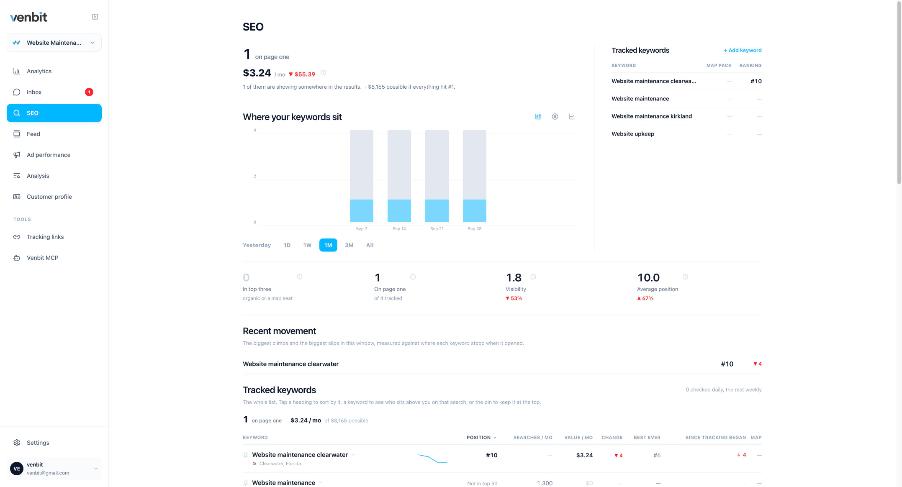
The screen above is the demo site's SEO tab, and every number in these screenshots is from that demo site. Recent movement is the list the alerts are drawn from: 'Website maintenance clearwater' sits at position 10, down 4. A slide of four or more places from there, held across three checks, is the push you would receive. The table under it keeps the position, the map pack spot, searches per month, the change, the best position ever and the date tracking began for every keyword, so when a push arrives you can open the row and see whether this is a one-day dip or a slide.
The stat row above the table shows visibility, 1.8 on the demo site, and average position, 10.0. Visibility is the one I trust. Average position is a trap. Add one hard keyword to the list and the average gets worse on the day you did more work, and it treats positions 1 and 2 as one place apart when in clicks they are miles apart. Visibility gives each keyword a share of the clicks its position earns, averages that over every tracked keyword including the ones found nowhere, and comes out as a number from 0 to 100 that only climbs when the rankings improve.
One push a day, and a weekly ranking report only when something moved
Five keywords moving on the same day is one notification. Venbit sends one ranking push per site per day however many keywords changed, naming the first few and saying 'and N more' for the rest, because five separate buzzes about five keywords is not five times the information.
The Monday summary follows the same rule from the other direction. It only goes out in a week where something happened. A weekly 'nothing changed' is how a channel dies, muted by the third week and never read again, so an empty week sends nothing and the summary that does arrive is one you open.
Moves older than three days are not pushed at all. They still show in the SEO tab and the feed, but a notification about a change from last week is not news, and the point of a push is that it is.
Google review notifications, in the same feed
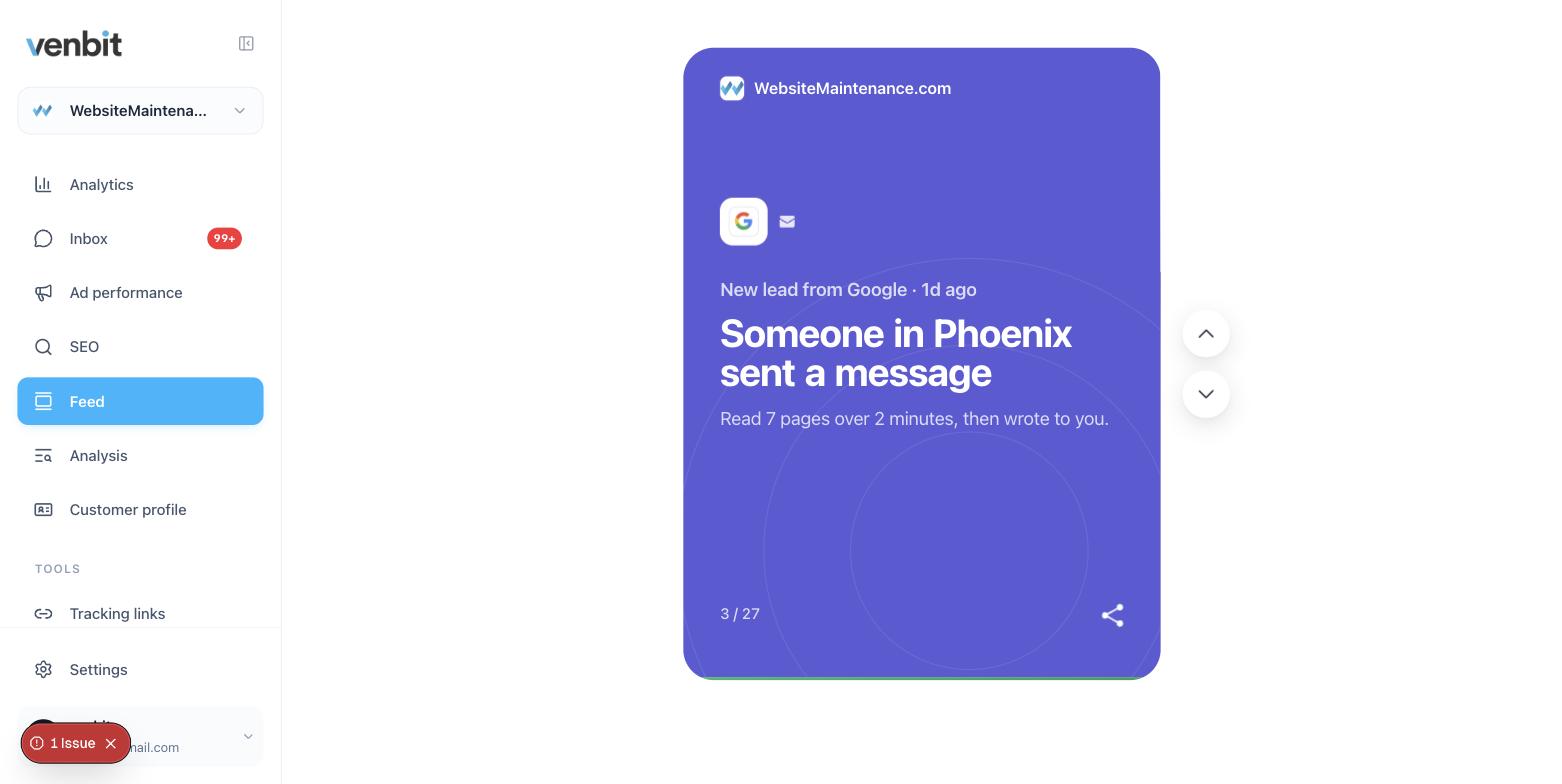
New Google reviews come through the same feed and the same push, next to leads and ranking moves, and there is nothing to set up. Once your Business Profile has been sighted in the map pack during a ranking check, Venbit knows the profile and pulls the newest reviews once a week, which is as fast as reviews move. The rating and the review count arrive with the map pack sighting itself.
The review texts sit in an accordion on the SEO tab, a handful and not an archive. A new one becomes a card in the feed and a push on your phone, one review push per site per day, so you hear about it whether or not Google's own email reached you. Getting more reviews is a separate job; knowing about the ones you already have is this one.
Where the alerts are set
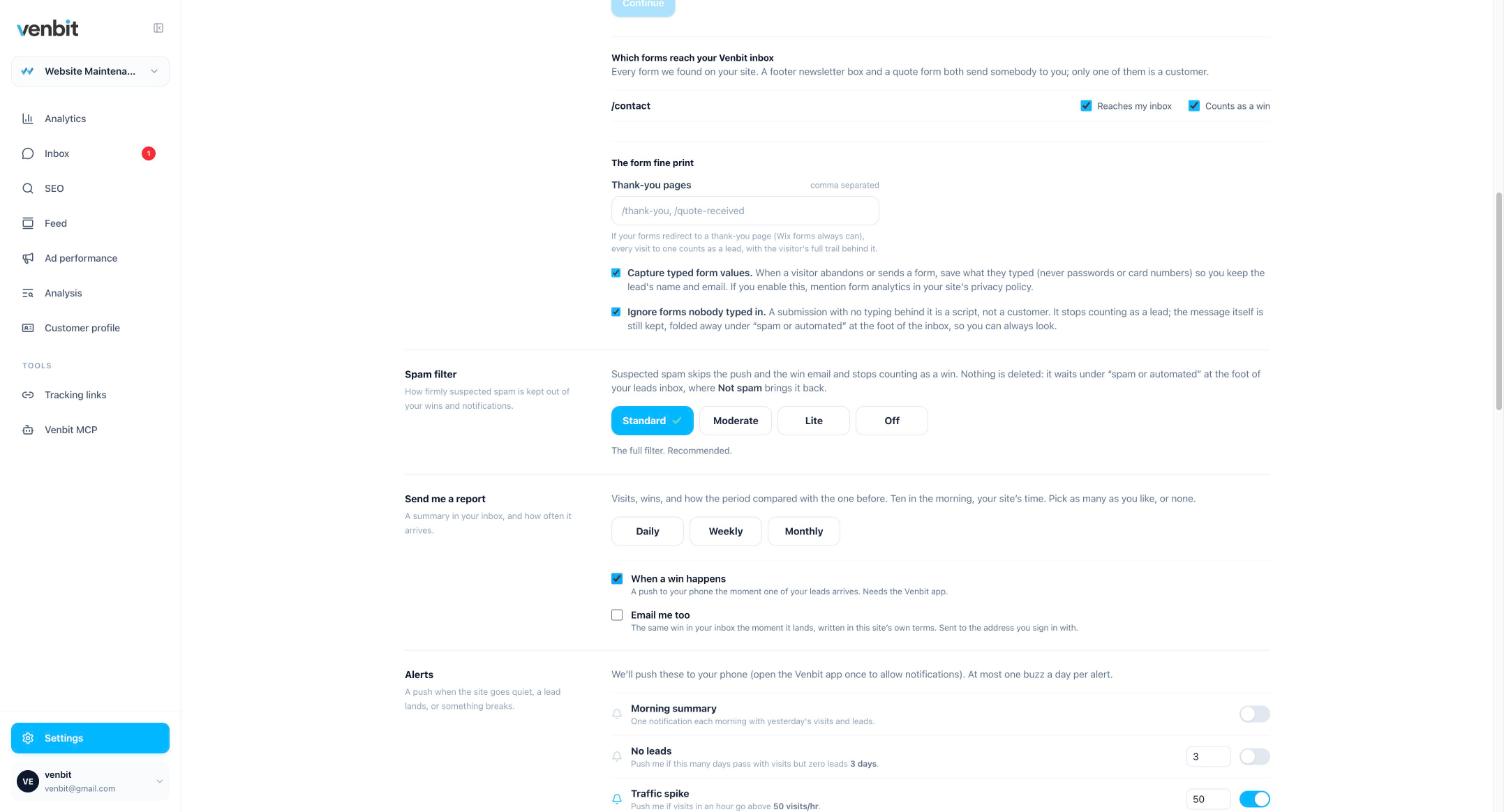
They live in Settings in Venbit's website analytics. Send me a report chooses the daily, weekly or monthly card and whether an email comes too; a push when a win happens covers leads and goals; the alerts below cover the site's health: morning summary, no leads after a number of days, a traffic spike above a number of visits an hour, an error spike and form abandonment. Ranking and review notifications are on by default for everyone with access to the site, and anyone who does not want them switches them off.
The push itself lands in the Venbit app for iPhone, with the keyword and the positions in it. A ranking alert at breakfast is a two-minute read. Open the keyword, look at the chart, see whether competitors moved above you, and decide whether it is a dip or a slide.
Rankings belong to the weekly look, with the alerts covering the days in between. What to check every day, and what to leave for the month puts them in their place in that routine, and a push is the one thing that moves a ranking check from Monday to today.
What an alert cannot tell you
It cannot tell you why. A keyword leaving page one is a fact; the cause is a competitor's new page, a Google update, a change on your own site, or a reading taken from a different place on a different day. Open the keyword and the companies ranking above you on that search are listed with their ratings, which answers the competitor question in one look. The position is drawn beside that week's visits and leads, so the first check is whether the drop in rank is matched by a drop in visits, and why website traffic drops suddenly walks through the rest.
It also cannot tell you about a search you are not tracking. The alert watches the list and nothing else. Tap Find them for me and Venbit reads what people wrote in your inbox to suggest the searches worth tracking, or add your own, and each one is checked for its Google position and its spot in the map pack from the city you name.
Related services
More on reading your website's numbers
Every question in this series, from Website Analytics for Small Business Owners.
Leads inbox4
Ad performance4
SEO tracking3
- How to Check Your Google Ranking From Another City (and the Map Pack)
- Does ChatGPT Recommend My Business? How to Check and Track It
- Google Ranking Drop Alerts and Review Notifications on Your Phone (you are here)
Visitor behaviour4
Feed and notifications3
Goals and measurement4

Tony Carnevale
Founder, Venbit
Tony started Venbit in Mill Creek, WA in 2011 and still does the work: web design, SEO, and the website analytics product the company builds and runs for its own clients. The numbers and screens in his articles come from that product, not from a content mill.