 Tony Carnevale
The short answer
Ask ChatGPT the question a buyer would ask, in the buyer's words, and see whether your business is named and where. One answer proves little, since the answers change between asks. Repeat it instead: put the same buyer questions to ChatGPT, Claude, Grok and Gemini, record who was named and what was said, and run it again next month.
Key takeaways
- Ask as a buyer, in a fresh chat: best plumber in Everett, who should I call for a leaking water heater near Mill Creek. Your brand name in the question tells you nothing.
- Write down three things per answer: whether you were named, where in the list, and the sentence the assistant used about you. The sentence is what the customer reads.
- The AI Visibility check asks ChatGPT, Claude, Grok and Gemini the buyer questions for your category and city, and records whether you were named, your position in each list, and what was said.
- The assistants learn about you by reading your site. The AI search section names the AI crawlers it can see; on the demo site Meta AI read 90 pages, and ChatGPT sent 26 visits that became no leads.
- A probe that failed is recorded as unknown, which is different from not being mentioned. The report keeps the two apart.
Open ChatGPT in a fresh chat, ask it the question a customer would ask, and read the answer. Who is the best roofer in Lynnwood. Who should I call for a cracked sewer line near Bothell. If your business is in the list, note where. If it is not, you have your answer for today, and today is the important word.
Ask again tomorrow and the list can be different. These assistants write a fresh answer every time, some of them search the web as they write, and the businesses they name shift between asks. So one check tells you less than it feels like it does. What tells you something is the same handful of buyer questions put to the same assistants month after month, with each answer written down, so you are reading a line and not a point.
How to ask it properly
The question has to be the buyer's, not yours. Typing your company name and asking whether it is any good tells you what the assistant knows about the name, which is a different thing from whether it would offer the name to a stranger. Use the category and the place, in the words a customer uses, and ask in a new chat each time so the earlier answers do not shape the next one.
Four or five questions cover the ground for most local businesses. These are the ones I use, with the towns swapped for yours.
- Who is the best electrician in Marysville.
- Who can replace a garage door spring in Renton this week.
- I need a dentist near Edmonds, who do you recommend.
- Who does affordable blind installation around Kirkland.
- My furnace stopped in Everett, who do I call tonight.
Put each one to ChatGPT, Claude and Gemini, and write down three things per answer: whether you were named, where in the list, and the sentence the assistant used about you. The sentence matters as much as the position. It is what the customer reads, and it is where you learn the assistant thinks you are in the wrong town or no longer do the service.
Why the answer keeps changing
An assistant composes a fresh answer each time from what it has read, so nothing holds still. What it has read about your trade in your town is a mix of your website, your Google Business Profile, your reviews and the directories that list you. A small change in the question, or in what the assistant found that day, reorders the names.
The reading has to be repeated to mean anything. A ranking position is one reading from one place on one date and I say that about Google. The same is true here, with the extra wrinkle that there are three assistants and each has its own view of your town. What you want is the trend: named in most answers, named in some, or named in none.
How the assistants learn about you
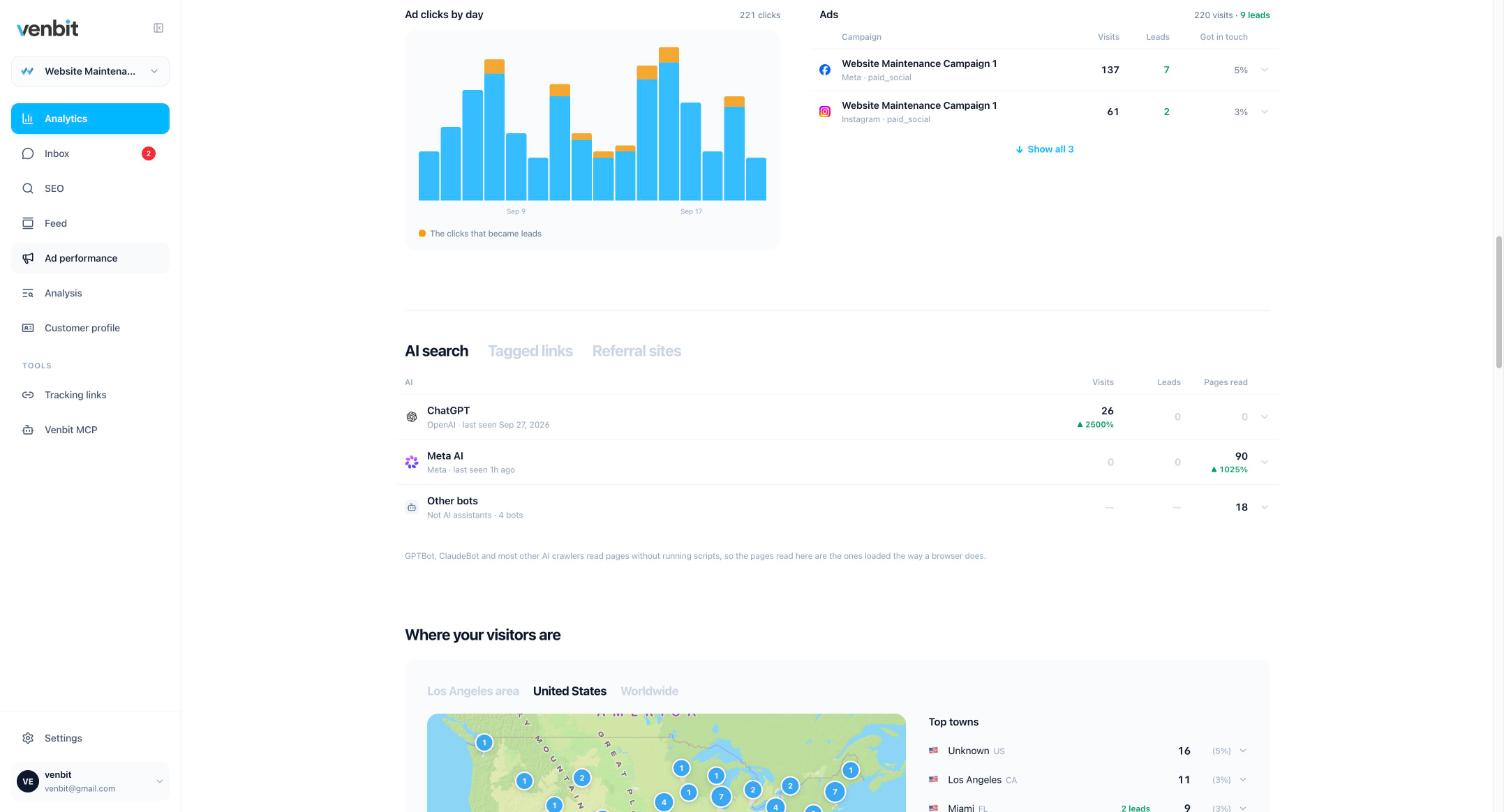
The assistants read your website with their own crawlers, and that reading is how your business gets into an answer at all. Venbit's analytics names the AI crawlers it can see in the AI search section of the dashboard, with the pages each one read. This is our demo site, WebsiteMaintenance.com, and every number read from a screenshot on this page is from it. Meta AI read 90 pages in the window shown and other bots read 18. The note on the screen says that GPTBot, ClaudeBot and most other AI crawlers read pages without running scripts, so the pages counted here are the ones loaded the way a browser does, and the true amount of crawler reading is higher than the screen can show.
A crawler reading your pages is the precondition for a recommendation, and no more than that. If no assistant's crawler has read your site, none of them can quote it, and the business named instead is the one whose pages were read. This screen shows part of that reading and never all of it, so it is a sign that the crawlers are here, never a full count of them.
The other half of the same screen is the people an assistant sent. ChatGPT sent 26 visits to the demo site in the window, and none of them became a lead. That is a real number and an honest one. Being recommended and being chosen are two different events, and the site only gets credit for the second.
How many visitors ChatGPT sends today
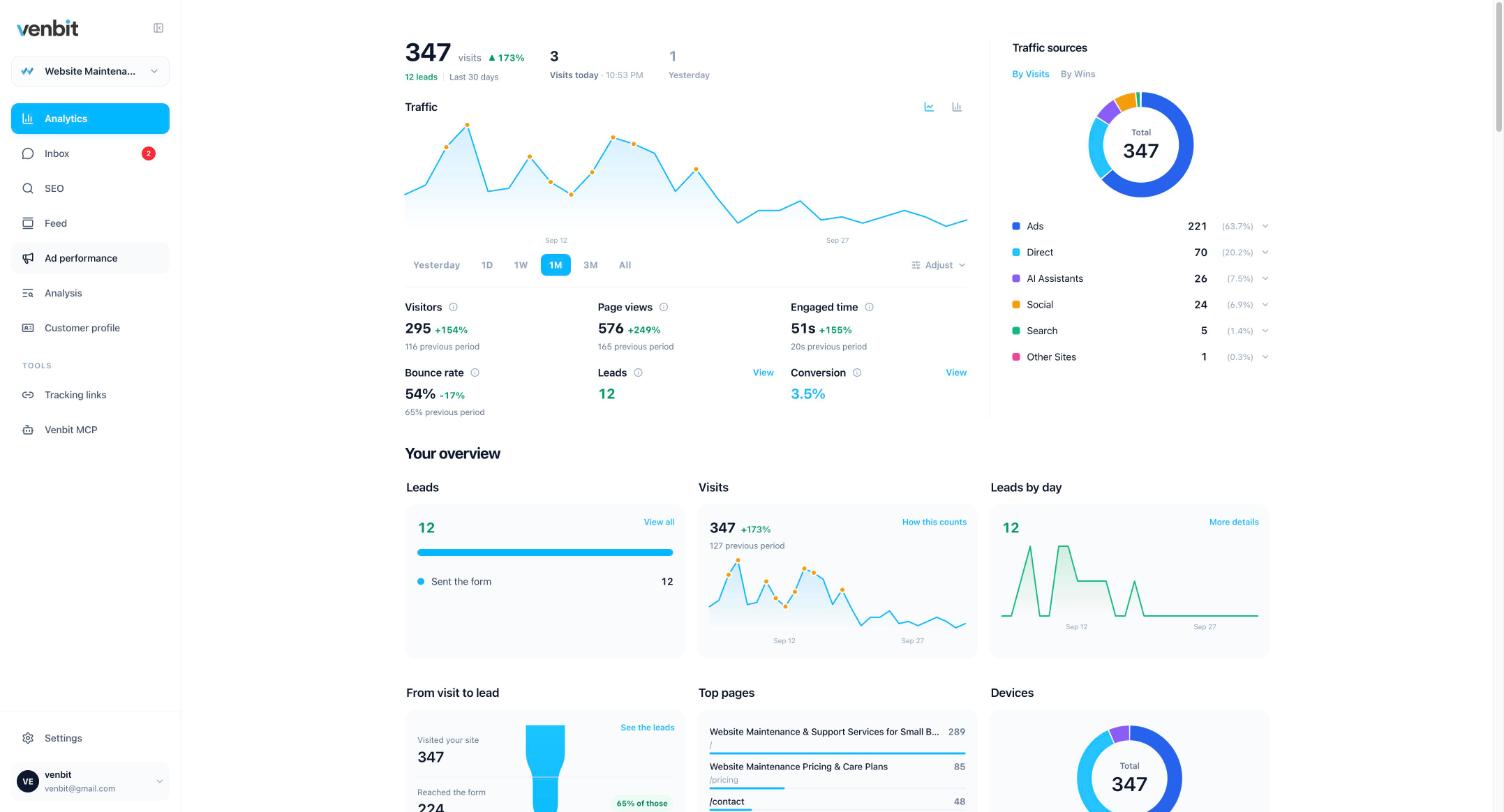
On the dashboard the assistants are a source like any other. The demo site's donut for the last 30 days reads Ads 221, Direct 70, AI Assistants 26, Social 24, Search 5. ChatGPT and Copilot tag the links they hand out with their own utm_source, which is how those 26 visits are filed under AI Assistants and kept out of the ad campaigns, where a less careful tool would list them as a campaign nobody bought.
Twenty-six visits is small beside 221 from ads, and that is the honest picture on this site this month. The reason to track it anyway is that the number was zero two years ago on every site I look after, and the question asked at the counter, did you find us on Google, now gets the answer I asked ChatGPT.
If you would sooner ask about your own numbers than read tabs, the Venbit MCP server hands your analytics to Claude with one key, so the question how many visits did ChatGPT send me last month gets answered from the data in a sentence.
Tracking AI visibility without asking by hand
The manual check works, and it is slow. The AI Visibility check asks the assistants for you. You give it the business, what it does and the city, and it puts the buyer questions to ChatGPT, Claude, Grok and Gemini the way a shopper would, each with its live web search on, and records each answer: whether at least one assistant named the business, your position in that assistant's list when it did, the businesses it named with the best first, and what the assistant said, so the report can show receipts beside every row.
Each assistant gets a scorecard of how many of the buyer questions it answered, and a probe that failed is recorded as unknown, which is kept apart from not being mentioned. An assistant that would not answer is a different fact from an assistant that answered with someone else, and a report that blurs the two is not worth reading.
Run it again next month and set the two reports side by side. The answers change, and the record is the point. The iPhone app keeps your past checks under the newest one, and the feed shows the last check as a card: asked an AI for your category in your city, and which assistants said yes.
What gets a business recommended
I do not have a formula for getting named, and nobody who claims one has shown their working. What I can say from the answers I have read is that the assistants are drawing on the same sources Google already shows: the business's own pages, its Google Business Profile, its reviews and the directories that list it. A business whose site says plainly what it does and which towns it serves gives the crawler something to quote. A site that says welcome to our website gives it nothing.
Reviews come up in the answers again and again, in the sentence the assistant writes about each business. How to get more Google reviews is the work there, and it is the same work that moves the map pack.
The profile is the other source the assistants lean on for hours, address and category. Setting up a Google Business Profile properly is free and takes an afternoon, and an incomplete one is how an assistant decides you are in the wrong town.
Beside the rankings
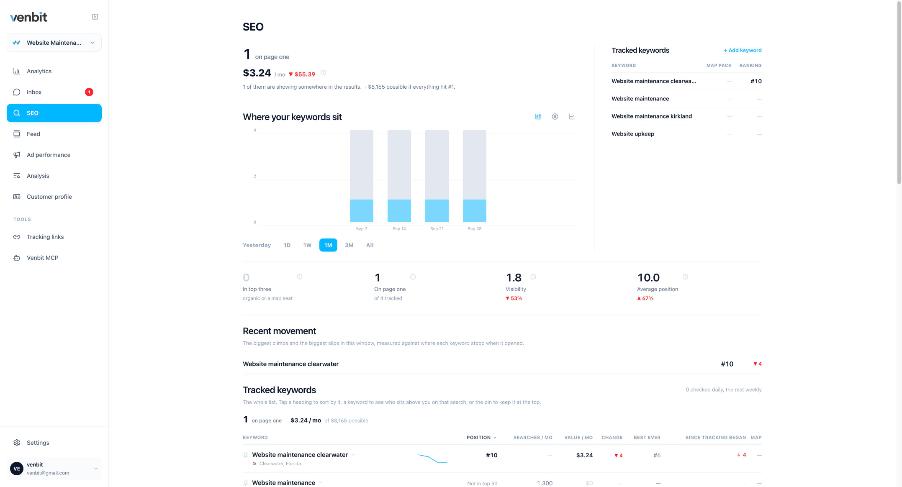
The AI reading belongs next to your Google rankings because it answers the same question from a second direction: would a stranger in your town, asking for what you do, be pointed at you. On the demo site the SEO tab tracks one keyword, Website maintenance clearwater, at #10 and down 4 since the last check. A Google position and an assistant mention can disagree, and when they do, the disagreement is the finding.
The rankings themselves are measured from a city you choose, which matters here too, since the buyer questions above all carry a town. How to check your Google ranking from another city covers that side.
The Venbit app for iPhone carries both: the SEO tab with its keywords and competitors, and the AI Visibility check with your past results under it, so the reading from the customer's town and the reading from the assistants travel together.
And if your Google rankings are the weaker of the two readings, how to get on the first page of Google is still the larger job. The assistants read the same pages Google ranks, so the work is shared.
Related services
More on reading your website's numbers
Every question in this series, from Website Analytics for Small Business Owners.
Leads inbox4
Ad performance4
SEO tracking3
- How to Check Your Google Ranking From Another City (and the Map Pack)
- Does ChatGPT Recommend My Business? How to Check and Track It (you are here)
- Google Ranking Drop Alerts and Review Notifications on Your Phone
Visitor behaviour4
Feed and notifications3
Goals and measurement4

Tony Carnevale
Founder, Venbit
Tony started Venbit in Mill Creek, WA in 2011 and still does the work: web design, SEO, and the website analytics product the company builds and runs for its own clients. The numbers and screens in his articles come from that product, not from a content mill.